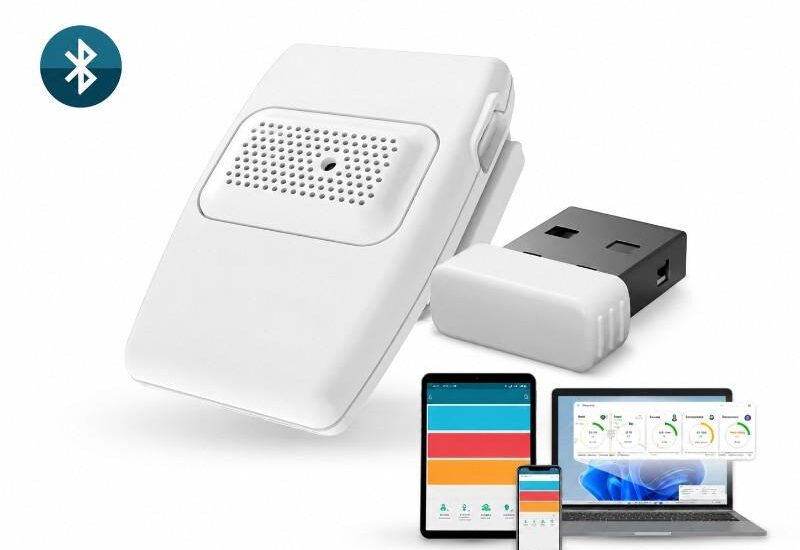
If you’ve ever wondered what’s actually floating around in the air inside your home, you’re not alone. The EPA estimates that indoor air can be two to five times more polluted than the air outside — and most of us have no idea. That’s where an indoor air quality (IAQ) monitor comes in, and the HibouAir Smart Air Quality Monitor is one of the most affordable options on the market that actually delivers comprehensive data.
I tested this device in my home to see whether it lives up to the hype. Here’s everything you need to know.
What Is the HibouAir Smart Air Quality Monitor?
HibouAir is a compact, plug-in indoor air quality sensor designed for homes and offices. Unlike many budget monitors that only track one or two metrics, HibouAir measures a wide range of environmental elements — all viewable through a clean mobile or desktop app.
There are two versions available:
- Standard Smart Monitor – measures PM 1.0, PM 2.5, PM 10, VOCs, temperature, humidity, and pressure.
- CO2 Version – adds carbon dioxide measurement on top of the above.
For this review, I tested the standard version, though I also had access to CO2 readings during testing.
Design & Build Quality
The HibouAir has a clean, minimalist look — rectangular with rounded corners, matte white plastic, and a small grille that allows air to pass through the sensors inside. It’s noticeably smaller and lighter than most competing monitors, making it easy to place on a desk, shelf, or mount on a wall without it looking out of place.
There is no built-in display, which may disappoint some users. All readings are shown exclusively through the companion app. However, this design choice keeps the device slim and affordable, and the app more than compensates.
Power comes via a micro-USB cable and wall adapter, both included in the box.
Setup & Installation
Setup was refreshingly simple. I plugged in the device, downloaded the app, and within a couple of minutes I was already viewing live air quality data. No complicated pairing process, no technical steps — it just works.
The device can also be wall-mounted if you prefer a permanent installation. Clear instructions are included, and the whole process takes only a few minutes.
What Does It Measure?
This is where HibouAir genuinely stands out for its price point. It tracks:
- PM 1.0, PM 2.5, PM 10 — fine particles that can penetrate deep into the lungs
- VOCs (Volatile Organic Compounds) — chemicals released by cleaning products, paint, furniture, and cooking
- CO2 (CO2 version only) — an indicator of ventilation quality and potential airborne germ risk
- Temperature
- Relative Humidity
- Air Pressure
Many similarly priced monitors — including the popular Aqara sensor — skip PM and CO2 entirely. HibouAir covers almost every major air quality metric that matters for a healthy home environment.
The App Experience
The HibouAir app is available for both mobile and desktop, which is a genuine advantage over most competitors that offer only a phone app. This makes it particularly useful for office environments where a desktop dashboard is more practical.
Key app features include:
- Color-coded air quality indicators — green for good, yellow for moderate, red for poor
- Historical data — view readings for the past hour, day, or full week
- Multi-device access — multiple phones or desktops can read data from a single sensor simultaneously
- Per-metric breakdown — each pollutant has its own color-coded status line
During my testing, CO2 levels registered as good when I was alone in a well-ventilated room. VOC levels climbed noticeably when I was cooking on a gas stove — exactly the kind of real-time insight this device is designed to provide.
Performance & Accuracy
For a consumer-grade monitor at this price, the HibouAir performs reliably. The readings responded quickly to environmental changes — opening a window lowered particulate readings within minutes, and the VOC spike during cooking was clearly captured in real time.
It won’t match the precision of laboratory-grade equipment, but for everyday home and office monitoring it provides consistent, actionable data that helps you make smarter decisions about ventilation, cleaning, and air purification.
Pricing & Value
Price is arguably HibouAir’s biggest selling point. Most full-featured IAQ monitors cost between $200 and $300. HibouAir delivers comparable sensor coverage at a significantly lower price, making it accessible to a much wider audience without major compromises in functionality.
Pros & Cons
Pros
- Affordable compared to competitors
- Tracks PM 1.0, PM 2.5, PM 10, VOC, temperature, humidity, and pressure
- CO2 version available
- Desktop and mobile app support
- Stores 7 days of historical data
- Multiple devices can read from one sensor simultaneously
- Compact and attractive design
- Quick, easy setup
Cons
- No built-in display — app required to view data
- Powered by micro-USB only, no battery option
- CO2 measurement requires purchasing the separate CO2 version
The HibouAir Smart Air Quality Monitor is one of the best value IAQ monitors available for home and office use. Its combination of comprehensive sensor coverage, clean app experience, desktop support, and competitive pricing makes it hard to beat at this price point.
If you want to understand what’s in the air you breathe every day — without spending hundreds of dollars — HibouAir is a smart, practical choice.